
April 13, 2020

Application Pic 1
Blog

With the spread of the coronavirus pandemic, it seems that we are getting in new information every day. Much of that consists of how the virus is spread and what behaviors and activities make you more or less susceptible to contracting COVID-19. We have some idea of how the virus can be transmitted through certain surfaces like

  •  Boxes and bags.
  •  Clothes.
  •  Countertops.
  •  Other surfaces in and out of your home.

But how much do we know about how the virus spreads through the air? CDC recommends social distancing, and that a safe distance to maintain from others is at least 6 feet. More is better if you can. 

One question that we have been getting recently is in regards to spreading COVID-19 through your home or office air conditioning system. 

Can COVID-19 Spread Through Air-Con Systems?

Thankfully, there is no current evidence that supports that COVID-19 can be spread through air conditioning systems. This was recently supported by Professor Leo Yee Sin, who is the executive director of the National Center for Infectious Disease (NCID). 

A recent study by NCID researchers did find that the virus that causes COVID-19 could be found in isolation facilities, which included air ducts that were connected to the rooms of infected patients. However, the research did not support that the disease is an airborne one. The preliminary research that we have on COVID-19 as of now shows that respiratory droplets are the main transmission mechanism through which the virus is spread. 

That NCID study, which was just published in JAMA in the last few weeks, did find that patients that had been infected with the virus could cause sizable contamination to their immediate surroundings. This was specifically in regards to their isolation room before it had been cleaned. 

This study examined samples from the toilet bowl and sink of a single patient that had tested positive for the virus. Pre-cleaning, those surfaces tested positive, but after cleaning, the test samples from these areas came back negative. This was not only a way of testing for the virus on surfaces but also a way to assess if the current means of decontamination were effective. 

Though this prompted headlines around the globe that the airflow of water droplets could be a means for transmission. Professor Leo has gone on to explain the purpose of the study was to examine environmental contamination. Not how the virus is spread. 

We have seen that the virus can be transmitted via surfaces in isolation facilities. To find out if the virus can be transmitted by air and not just through respiratory droplets, this requires a different set of experiments and testing. 

Professor Kenneth Mak (director of medical services at the Ministry of Health) said the discoveries that were made in this recent NCID study were indeed in line with what we currently know about the virus being transmitted primarily through respiratory droplets. He also noted that there are some significant differences in isolation facilities’ air conditioning and ventilation systems when compared to the ones that we have at home. 

In most homes, air vents are located higher in the room, whether on the walls or in the ceiling. In isolation rooms, vents are typically located around the floor or at the bottom of a room. This can lead to respiratory droplets collecting around them via sneezing, coughing, and gravity pulling those droplets down and around those vents. 

With vents and vent systems located higher in individual rooms and not necessarily open in a way that would expose it to contamination, it would be highly unlikely that COVID-19 could spread through your air conditioning system or your home’s ventilation. 

Say you are in a home with 3 other family members, and one of your family members tests positive for the virus. With the information and research, we have access to now, self-quarantining them to a room or closed off area of your home is effective for the spread of the virus. 

With what the most recent research shows, it seems highly unlikely that this infected individual could sneeze and spread the virus through the ventilation or air conditioning system in your home. It is far more likely that another individual in your family would contract the virus by being exposed to it through:

  •  Respiratory droplets.
  •  Surface contact.
  •  Contaminated clothing or fabric. 

As of now, we do not have supporting evidence that shows that COVID-19 can be spread through our home air conditioning and ventilation systems. With the proliferation of international news during this time, we can expect that the CDC, WHO, as well as other national, regional, and international health organizations, will be reporting any updates on the spread and transmission of the virus, if and when they discover new information.
swamp coolers stablel
Blog

There are many ways that you can effectively cool your home, office, or work area, no matter how great or small it is. Thankfully, air conditioning and climate control technology gives us a variety of effective options for keeping our immediate environment at a comfortable temperature. 

One question we get quite often in our field is “what is the difference between air conditioners and evaporative coolers?” Many people believe that cooling technology is cooling technology, and as long as the result is a cooler environment, it doesn’t really matter how you get there. The reality is that the most effective method for cooling your immediate environment is dependent on several key factors. That being said, there are some unique benefits of using evaporative coolers vs. air conditioners and vice versa, depending on your needs and circumstances. 

Key Takeaways on Evaporative Cooling

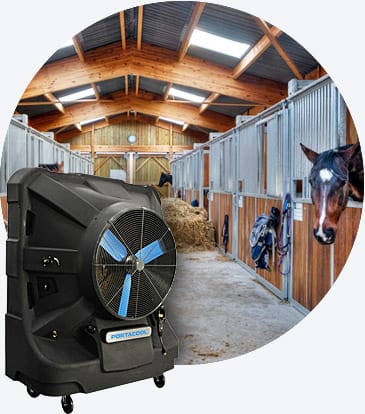
Evaporative coolers, also known as swamp coolers, are great for cooling large areas, especially in dry, hot climates and weather. Here are some of the key takeaways and top things you need to know about evaporative cooling, including some of the unique benefits and costs associated with it: 

  • They are economical to use and operate. 
  • Evaporative coolers are very energy efficient. 
  • They work really well in hot, dry climates. 
  • They produce fresh clean air to circulate around your home or surrounding environment. 
  • They are inexpensive to install. 
  • They require very little in terms of maintenance. 
  • They are environmentally friendly and have very low carbon monoxide emissions. 
  • Evaporative coolers add cool moisture to the air. 
  • They allow for open doors and windows. 
  • Evaporative cooling units don’t make a lot of noise while they are running. 

Overall, there are a lot of unique benefits that come with installing and using an evaporative cooler (or swamp cooler) in your immediate vicinity. 

Key Takeaways on Traditional Air Conditioners

Air conditioners and AC units are what we think of when we consider cooling in homes, offices, and other climate-controlled areas. Here are some of the key takeaways, unique benefits, and costs of using a traditional air conditioner vs. other methods of cooling. 

  • They have a higher operating cost than other cooling systems. 
  • Air conditioners also use more energy than evaporative coolers and other forms of cooling. 
  • Air conditioners are effective in any climate imaginable, both humid and dry weather. 
  • They use recirculated air to cool the air in the surrounding indoor environment.
  • They have much higher upfront installation costs than other forms of cooling. 
  • Air conditioners require regular cleaning and maintenance. 
  • AC units have much higher emissions in comparison to other cooling systems. 
  • They remove moisture from the air, to take advantage of dry cooling.
  • They are very effective in enclosed spaces like homes, rooms, and offices. 
  • They can make a lot of noise when they are running. 

Air Quality of Evaporative Coolers vs. Air Conditioners

Evaporative coolers work best for circulating outside air throughout your home, office, or the environment they are set up in. This keeps fresh air in the area and keeps it from becoming stale. Traditional air conditioning unit technology takes the air from within a home or area, processes it through the cooling system, and recirculates that cooler, interior air within the home. This process is efficient but can lead the inside air to feel staler. 

For air conditioning units to work at maximum efficiency, you need to make sure that your windows and doors are closed. Conversely, you can use evaporative coolers with windows and doors open. 

Operational Costs of Evaporative Coolers vs. Air Conditioners

Most evaporative cooling units or swamp coolers are incredibly energy efficient, which makes them a nice choice for people who want to pick a cooling solution that is a little more economically conscious. One of the reasons that many people really like using evaporative coolers for keeping an area cool is because they cause far less to install and they are very inexpensive to maintain and repair. 

With that, you can get evaporative coolers that are mobile, so you can roll or relocate them to different areas that you need them in. As long as you give your evaporative cooler some minimal seasonal maintenance, it should work in tip-top shape for years to come. Evaporative coolers work best and most efficiently in areas that are dry and hot. They don’t work as well or seem as effective in areas of high humidity. 

Operational costs of air conditioners are relatively low as well, but they do require more in ongoing maintenance. Since many AC units are housed outdoors, they need a little more maintenance than indoor evaporative coolers. The benefit of a central air conditioning unit is that it can efficiently cool a larger area than an evaporative cooler. 

Moisture levels of Evaporative Coolers vs. Air Conditioners

Evaporative coolers add moisture to the air in your surrounding environment. It works to cool your home, office, or immediate area through the process of evaporation. That makes them great for people with dry eyes and dry skin. Traditional air conditioners work to remove moisture from the air, to make the air less wet and humid. 

Environmental Concerns of Each

Traditional air conditioners take a lot of energy and power to run and typically have higher levels and rates of emission than evaporative coolers. The upside is the AC units are powerful enough to cool an entire house or a large indoor area. Evaporative coolers have much lower emissions than AC units. They also cause far less noise pollution than traditional air conditioning units, if that is a concern in your area. 

Other considerations

The type of cooling system that you choose is largely dependent on when, where, and how you intend to use it. Swamp coolers and evaporative coolers are great for hot, dry climates and cooling smaller areas, whereas ACs provide a dryer air and are able to larger areas much cooler.

Scroll to Top