Temperatures are rising, and many places are already seeing heat waves. Are you ready for the Texas summer heat?
If not, or if you’re looking into climate control solutions anyway, you might be interested in learning about the innovations of evaporative cooling. In this post, we’ll be talking about everything evaporative coolers.
What is an Evaporative Cooler?
An evaporative cooler is a type of air conditioner that cools the air through the power of evaporation. As water evaporates, turning from a liquid into a gas, it cools whatever it’s touching.
You’ve probably noticed that the air is cooler around a body of water on a hot, sunny day. That’s evaporation at work! That’s also why we sweat; our sweat evaporates off our skin and cools us down.
Evaporative coolers harness this power in order to work as air conditioning. The unit takes in the hot air around it and sends it across its cooling pads.
The pads soak up water from a tank in the cooler, like a sponge, and saturate all of its layers. Water evaporates off the pads, cooling the air. The unit then releases that cooled air back into the room.
Why Use an Evaporative Cooler?
There are many benefits to using an evaporative cooler over other air conditioning systems:
- Evaporative coolers lower the temperature in a room by up to 20 degrees without sucking out all the humidity. Even in humid environments, traditional air conditioners can lower the humidity level in a building to the point that people inside can experience dry skin. Evaporative coolers cool the air using water, so humidity doesn’t get lost along the way.
- Evaporative cooling can clean the air, reducing allergens. When water evaporates, it leaves behind any non-water stuff. Air that passes through an evaporative cooler, especially one equipped with allergen reducing microfiber-enhanced cooling pads, gets cleaned through evaporation. Any gunk that may have been in the air gets stuck in the pads instead of your nose.
- By using water instead of Freon to cool down the air, evaporative coolers are more environmentally friendly than traditional air conditioners.
- If you are conscious about energy consumption, evaporative coolers use less than half the electricity an air conditioner uses. Evaporative coolers only use 1.5 kilowatts of electricity, which is good for the planet and your wallet.
- You can even use an evaporative cooler outdoors. If you want to sit out on the porch or patio but it’s just too hot, an evaporative cooler can cool down your favorite spot and make it usable again.
Evaporative Coolers: Facts and Figures
Did you know that an evaporative cooler can save you up to 30% on your energy bill? It’s true! The cost of running this type of cooling unit only costs about one dollar per 8 hour day using home electricity.
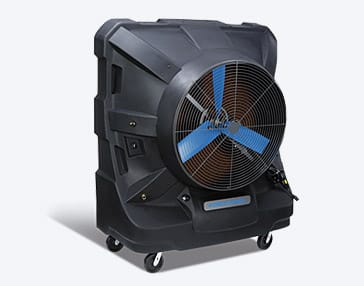
They’re not just for cooling tiny rooms, either. At Preferred Climate Solutions, we offer Portacool evaporative cooling units. Their JetStream 220 unit can cool up to 700 square feet, and that’s just the smallest unit. The largest we offer is the JetStream 270, which can cool up to a whopping 5,625 square feet at a fraction of the cost of operating a traditional air conditioning unit.
Cons of an Evaporative Cooler
We’ve talked about the benefits of evaporative cooling, now let’s look at the aspects that may make it the wrong choice for your needs. Here are the cons associated with an evaporative cooler:
-
Frequent Maintenance
Because evaporative coolers are constantly passing the air through their cooling pads, sediment can build up in the unit. When using the cooler constantly, such as during summer, the pads and filters need to be changed as frequently as once per month. Otherwise, you’ll need to change them twice or more while they’re in use.
You will also need to check for and clean out any sediment buildup throughout the unit regularly. The unit requires deep cleaning every year to keep it running smoothly and safely. However, you can perform all the routine maintenance by yourself without having to call in a professional.
-
Not Ideal for Humid Climates
Evaporative coolers add humidity to the air as part of their operation. Because of this fact, they can’t work as effectively in places that are already humid, if at all. In places that are mildly humid, an evaporative cooler may add humidity and exacerbate any problems with humidity such as mold growth.
-
Not Ideal for Locations with Limited Access to Water
As you can imagine, these machines use water. While they are environmentally friendly in the sense that they aren’t using harmful Freon to cool the air, they are not ideal for use in places that frequently experience droughts. You should also refrain from using them when your area is under water use restrictions.
They would be effective in desert climates, but not without free and ready access to water. If you’re conserving water, don’t use an evaporative cooler.
-
Not as Cold as an Air Conditioner
Evaporative coolers cool the air naturally. As with a lot of natural things, it’s not as powerful as industrial solutions. Where an air conditioner can get you pretty much as cool as you want, evaporative coolers are limited to about a 20 degree or less decrease in temperature.
If it’s 115 degrees in the shade, an evaporative cooler might help a little but it won’t get your house down to a cool 72 like a traditional air conditioner might.
As we discussed, evaporative coolers are a natural, energy efficient method of cooling that can save you a good chunk of money on your energy bills. They use water instead of Freon to cool the air, and even clean the air as they cool it. However, they do have some drawbacks, mostly depending on where you live and how much maintenance you’re comfortable with.
If you’re interested in trying out an evaporative cooler for yourself, we can certainly help! At Preferred Climate Solutions, we’ve been providing the Dallas-Ft Worth, Austin and Houston areas with top of the line HVAC services for the better part of 17 years. Contact us today to ask about our evaporative cooler renting options or for more information. We have the experience to help you with all your heating and cooling needs.