For those of you looking to beat the heat in the summer, it’s important to know that you have several options. While a standard central or portable air conditioner unit is a usual choice, there are other ways to keep cool. One of those ways that you might have heard about before is a swamp cooler.
What Is a Swamp Cooler?
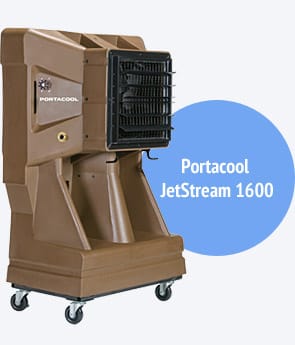
A swamp cooler is a type of low-maintenance, lower-energy air conditioning that relies on the evaporation of water vapor to cool an area. These units blow hot, dry air over moisture-laden pads. These pads allow the air to pick up moisture and bring it into the room, where it then acts to cool down the space.
This is actually a method that has been used for thousands of years in more basic formats (such as hanging wet sheets outside of an open window and letting the wind take over) but it doesn’t work in all situations.
What’s the Science Here?
So now that we have the basics out of the way, let’s get into the more nitty-gritty science to learn just how swamp coolers work.
Humanity has long known that things that are wet tend to feel cooler. If you’ve ever licked your finger then held it up to the wind, you’ve noticed this. That coolness comes from the moisture on your finger evaporating in the wind. As moisture evaporates, it draws heat into the air and away from the body, cooling you down. Our own sweat works on much the same principle: as the sweat evaporates from your skin, it cools you down.
Swamp coolers use that same effect, pumping air full of evaporated water droplets into a space. These droplets actually draw the heat from the room as they enter, cooling it down. The result is a cooler, more humid space than you initially started with.
Can Swamp Coolers Work for Everyone?
Unfortunately, the answer to this question is no. You might have noticed in that last paragraph that a room cooled with a swamp cooler ends up being more humid than before. Because of this, and because of the way these units work, swamp coolers are really only effective in dryer conditions. If you live in more arid climates, such as the southwest, then a swamp cooler might just do the trick, However, if you live in the southeast, or any other part of the country known to be more humid, than a swamp cooler can actually end up making things worse by making the air even more humid than it was to start with.
In addition to that, swamp coolers don’t really work in huge spaces. This is because the air they pump into a room needs to be able to exit the room somehow. This is a basic rule of physics: you can’t put material into a space without there being room for it. Just like you can’t put more water into a glass if it’s already full, without some water leaving, you can’t put more air into a room without a way for the air that’s already in there to escape. In a normal air conditioning unit, air is drawn out of the room and back into the unit through a series of intake ducts.
With a swamp cooler, this same problem is usually solved by opening a window or two (this is because swamp units aren’t typically centrally located, so they don’t have intake ducts to rely on.) The result is a less efficient system of air escaping, which means that they can’t cool as large a space as a typical a/c unit.
Swamp Cooler Maintenance
So, you might be wondering why these units are called swamp coolers. It’s a bit of a misnomer, really, when you think about the fact that swamps are the sort of places these coolers are the least likely to work. While the origin of this name isn’t exactly clear, one theory is that these units, if not properly maintained, can get quite smelly. This is because swamp coolers draw air across a series of moisturized pads. If not cleaned or changed regularly, these pads can get quite smelly. The resulting odor is a thick, humid, musty smell – just like you might find in a swamp.
This brings basic maintenance to mind. While swamp coolers don’t have all the parts and complicated machinery of an air conditioner, parts do need to be monitored, cleaned and changed regularly in order to ensure your swamp cooler is functioning properly.
Swamp Coolers vs. Air Conditioning: What To Do
Now that you know a little about swamp coolers, you might be wondering which sort of cooling system is best for you. It all boils down to where you live and what you’re trying to cool. Here are some things to keep in mind:
- Like we said above, swamp coolers only work well in dryer areas. If you live in a humid climate, then you’re going to want to use a regular air conditioner (which, ironically, still uses evaporation technology but works by getting rid of moisture in the air, not adding it!). The more humid the air, the less you’ll feel the effects of a swamp cooler until, at some point, it stops helping all together.
- Another factor to consider is room size. If you’re looking to cool a small space, then a swamp cooler can work for you. All you have to remember is to open a window or two, or leave some other way for inside air to escape. For larger rooms, the cooler becomes less effective as it can only blow so much air into a space at one time. Once you start looking at really large rooms, or multi-roomed buildings, the swamp cooler becomes more and more useless.
- A third item is maintenance and upkeep. In this category, swamp coolers win hands-down. They have fewer parts which cost less to buy, and they are much easier to maintain. Even better: swamp coolers use much less energy than air conditioners!
As you can see, swamp coolers can be a helpful unit in the right conditions. If you’re looking to cool off, one of these units might be just right for you.