
Author name: pcsadmin

PCS 2000
Blog

Your HVAC system may be one of the most valuable parts of your house. It’s the very thing that keeps your house comfortable year-round, through any season. Whether you have sweltering summers or blisteringly cold winters, you can always rely on your air conditioner or heating unit to keep your space at the perfect, most comfortable temperature.

For something that you use almost every day, year-round, how much do you know about your air conditioner and heating unit? Do you know how it works to keep your house cold or warm?

Don’t feel bad if you don’t know how to answer that question. Like many pieces of technology in our lives, most people don’t consider the inner workings of these devices and how they do what they do best.

A question that we get quite often is “what are the differences between an air conditioner and a heat pump?

Are they, in fact, the same thing?

What kind of unit do I have at my space and how do I tell?

Let’s take a look at some of the key differences between heat pumps and air conditioners.

Air Conditioners

Let’s first take a look at how your conventional air conditioner works. As simple as the idea of an air conditioner might sound, there are some common misconceptions about how an air conditioning unit works to keep your house cool.

Your standard air conditioner is designed to take in warm air from the outside of your house or the building that it is attached to. It pulls that air into its condensing unit, where the refrigerant in your air conditioning unit cools it down. After cooling the air, it pumps that cool air back through the ventilation system in your area. You could think of this as a two-stage process of cooling your space by pulling the warm air out, cooling that air, and recirculating that cooler air in your area. In terms of structure, your AC unit’s air condenser is located inside of your area, and the compressor can be found on the outside of your room.

Since the air conditioning unit itself can only blow cold air into your area, homes with their own AC systems need to have a separate furnace or heating unit that will heat your house, keeping it warm and comfortable during the cold days of fall and the frigid winter months of the year.

Heat Pumps

Think of the heat pump as a type of combination unit. It uses something that we refer to as reversible technology to circulate heat or air, depending on the season that you are using it in.

When it is hot outside during the late spring and summer, heat pumps can work just like your standard air conditioning unit. They pull hot air from inside of your space, cool it down, and then circulate it back through your house to make it cool and comfortable. With a name like “heat pump” most wouldn’t expect that it could also cool your house down.

What about heating your house during the cooler months of the year?

Heat pumps work well in the winter by drawing in the outside air and the ambient heat energy available in it to heat up your area.

Are There Advantages to One Over the Other?

Now that you have a better idea of how heat pumps and standard air conditioning units work, let’s take a look at some of the details. Does one of them offer distinct advantages that the other doesn’t?

Advantages and Disadvantages of Air Conditioning Units

Largely, we tend to see that air conditioning units have a longer viable working life than heat pumps. The main reason is that you only run your air conditioning unit for about half of the year, depending on where you live, which almost doubles the viable amount of use that you can get out of your air conditioning unit before it needs to be repaired or replaced.

Because they are simpler in design than heat pumps, AC units are also more affordable and cheaper to install than their heat pump counterparts.

If you do just have an AC unit, you will need a separate heating unit or furnace to heat your area during the winter months. A drawback of AC units is that they can be expensive, depending on the area that you live in and the cost of electricity. AC units need a lot of power to be able to cool and circulate air.

Advantages and Disadvantages of Heat Pumps

One of the best aspects of heat pumps is that they are incredibly energy efficient. Since they work to transfer ambient heat from the outside of your house to the inside of your house, the heat pump doesn’t have to work as hard as other heating units to heat the air.

As you may have gathered, another great aspect of using a heat pump is that it is an all-in-one solution. This saves some space and keeps all of your heating and cooling needs into one compact device. This also makes it easier when or if you need maintenance done on your unit.

However, there are some clear disadvantages to having a heat pump. Since they do pull ambient heat from the cold outside air to heat your area, heat pumps aren’t nearly as effective in brutally cold climates. They are far better in parts of the country that have moderate or light winters. Since the technology on them is more compact and advanced, the units themselves, as well as the installation, can be substantially more expensive than AC units. Heat pumps also wear out and burn out faster than AC units. Since you are using the same unit, year-round, their components can suffer wear and tear much more quickly.

Maintaining your AC Unit or Heat Pump

If you have more questions about maintaining your AC unit or heat pump or installing a new unit in your area, contact our experts at Preferred Climate Solutions today.
portacool pacjs2601a1
Blog

With the winter months just around the corner, you are getting ready to break out all of the mittens, scarves, and winter clothes. That also means that you are going to be getting a lot more use out of your portable heaters.

When you are breaking your portable heaters out of storage, the first thing that you think of probably isn’t “what’s the best way that I can take care of my portable heater this season?” On cold days, you are probably thinking “is this thing going to heat up any faster?

Whether you use your portable space heater regularly or infrequently throughout the fall and winter months, there are a few things that you need to keep in mind so that you can maintain your heater while using it as safely as possible.

Check Your Heater Right out of Storage

If the weather is already cold where you are, you are probably anxious to plug in your heater and get it working as soon as possible. Before you set your heater down, plug it in, and turn it on, you need to be careful. Your heater might not be in the same shape that it was when you put it away for storage last year.

Where and how you stored your heater last year can greatly affect the condition that your heater is this season. If you store your heater in a garage, attic, or basement that isn’t temperature controlled, there is a chance that your heater could have incurred some damage while in storage. If your heater may have been shuffled or knocked around with other things that you have put into storage, there’s an even greater chance that you could have caused damage to some essential components and elements on your heater.

How do you stay safe in this situation and make sure that your heater is in good enough shape to use?

Take a quick look over your heater to make sure that it

  •  Doesn’t have any major dents or dings
  •  The power cord isn’t damaged or frayed (see more below)
  •  That the switch seems to be working properly

When you have given your space heater a once-over to check for any damage or issues, you are one step closer to plugging it in and getting warm.

Be Aware of Your Power Cord

The power cord is one of the most important components of any space heater. To create the kind of radiant heat that space heaters do, they need to have a power supply to do that.

As we mentioned earlier, there is always a chance that your space heater could have incurred some damage while in storage, especially if it was being shuffled around with a lot of other objects while it was in storage. After you pull your heater out of storage, you want to make sure that your cord isn’t damaged or frayed. Using a damaged cord can lead to serious issues and malfunctions that could put you, your family, and your furniture at risk. If you have any visible damage done to your power cord, make sure that you talk to an expert and get it serviced as soon as possible.

It isn’t uncommon for power cords to have issues, even if they don’t have any visible damage. The first time you plug in your space heater out of storage, make sure that you keep an eye out on the cable and the power outlet that your space heater is plugged into. If you notice that the cable or the power outlet that the heater is plugged into starts to get hot, shut off your space heater immediately.

Be sure that you don’t run your space heaters power cord under any rugs, carpeting, or mats. This can not only quickly become a fire hazard, but the insulation from household floor-coverings like these can cause damage to the cord in a fairly brief period of time.

Check the Space Around Your Heater

For the purpose of maintenance and safety, you always want to make sure that you are aware of the space around your heater. Every year, there are thousands of households that experience preventable house fires that are caused by heaters that weren’t placed in a safe area of the house.

Space heaters put out a lot of heat and use a lot of power. That can make them and other objects around them highly flammable. As a good rule of thumb, be sure that your space heater is away from

  •  Any type of blankets
  •  Couches and sofas
  •  Chairs that are made out of fabric
  •  Clothing
  •  Fabric throw pillows
  •  Flammable liquids
  •  Thin fabric rugs, mats, or floor coverings

Anything that may catch fire easily. We also recommend keeping them away from the walls of your house. Place your heater near the middle of a walkway or open room to minimize your risk of a fire.

Don’t Leave Your Heater on and Unattended

Have you ever left your space for an extended period of time while your space heater is running?

How about letting your heater run overnight while you were sleeping?

If so, you were running a pretty sizable risk. Space heaters can make your life nice, warm, and comfortable, but leaving them attended always means that you are running a risk of something bad happening. To minimize the chances of your space heater causing a fire, you should never leave your space heater unattended for long periods of time. One little spark or a small malfunction of your heater could easily lead to a fire.

Have more questions about heating your space this winter? Contact our experts at Preferred Climate Solutions today.
homepage bg event
Blog

When it comes to climate control and comfort, one element that many people tend to overlook is humidity. Yes, the overall temperature of your interior spaces means a lot, but when your home or business is too humid, it can throw everything out of whack.

Fortunately, you don’t have to suffer from high humidity in your home or office. There are many different ways to reduce the moisture in the air to make it more comfortable. In this article, we’ll outline the various tactics you can use, as well as discuss why lower humidity levels are so beneficial.

Why Humidity Matters

If you’re curious as to why you should be focused on improving your home or business’ humidity levels, here are a few reasons.

Mold Growth

All buildings have some level of mold, but those that have higher than average humidity levels are much worse. Mold and mildew can grow unchecked when the air moisture is above 55%, which can pose a variety of health problems. Not only that, but mold can weaken certain parts of the building (i.e., drywall), which can lead to expensive repairs later on.

Lingering Smells

Bad odors can occur anywhere at any time, but they are so much worse in humid environments. The air moisture traps the smells on various surfaces, which can lead to a lingering odor. Not only that but as mold grows, it will emit its own scents as well, which are usually off-putting.

HVAC System

One of the primary problems with overly humid environments is that they are harder to control. It takes a lot longer for moist air to warm or cool, which means that your HVAC system or air conditioner will have to work a lot harder throughout the day. Reducing your humidity by just 10 percent can have a significant impact on your utility bill.

How to Reduce Humidity

Now that you understand the value of keeping your interior spaces cool and dry, let’s look at the various ways to reduce air moisture as much as possible.

Fix Any Leaks

Your primary concern should be to eliminate any water that shouldn’t be there. Leaky pipes, faucets, or drains can be a substantial source of moisture, which is why you need to fix them as soon as possible.

Another point of entry for leaks can be your roof or gutters. Make sure that you inspect these areas regularly, particularly after storms or high winds. The less water that can come in from the outside, the better off you’ll be inside.

Use Exhaust Fans

Most homes and businesses are equipped with various exhaust ports to remove hot and humid air already. An example would be a vent hood over your stove in the kitchen. It may seem unnecessary at times to run these fans, but you should always use them whenever appropriate. Steam can collect in the air and raise the humidity fast, so you want to remove it as quickly as possible.

Inspect Your Air Conditioner

One of the great things about A/C units is that they already dehumidify your home or business as part of their operation. However, that’s only the case when your air conditioner is working correctly.

If it’s been months since your last inspection or service, now is the perfect time to get it checked. Typically, dirty air filters can cause your A/C to work less efficiently, which can lead to higher humidity.

Another problem is when your air conditioner is too large for space. While it may seem desirable to have a high-powered A/C, the fact is that it can work too well, creating condensation in the process. Instead, opt for a slightly smaller model so that you don’t generate higher humidity by accident.

Buy Moisture-Absorbing Plants

For the most part, indoor plants will contribute to humidity. After watering them, they will “breathe” the excess moisture into the air. This is why jungles are so humid. However, certain species (i.e., ferns) can absorb more water than they expel, making them ideal for humidity control.

Be sure to do your research beforehand so that you know how to take care of the plant and that it will get the job done.

Cover Dirt-Floor Crawl Spaces

Dirt is notorious for absorbing moisture, which can contribute to humidity over time. Rather than cleaning the dirt, replace it with something less absorbent, like polyethylene. Depending on the size of your crawlspace, this fix can be relatively expensive, so see if you can correct your humidity problems with other methods first.

Use Charcoal

Interestingly enough, charcoal is one of the best materials to suck moisture from the air. If you already have some briquettes for your grill, you don’t have to buy anything for this quick fix.

Best of all, charcoal can work well for months at a time. Simply place a few pieces in an open container and let it sit. Ideally, you’ll place the charcoal in high-humidity places, like the kitchen, laundry room, or bathroom.

Use a Dehumidifier

In some cases, too much humidity can cause health problems for you or your family (or co-workers). In those situations, a high-quality dehumidifier is probably the best option. These machines are highly efficient and can dry the ambient air much faster than other methods. That being said, we recommend them only when your humidity levels are over 60 percent, or if it’s medically necessary.

Take Cooler Showers

A primary source of steam is most likely your shower. Every time you bathe, you are pumping gallons of water into the air. To help alleviate this load, you should start taking colder showers to produce less steam. Otherwise, install an exhaust fan and use it every time you clean up.

Contact Preferred Climate Solutions Today

When it comes to managing humidity, we can help. The right system can make a world of difference. See how we can make your home or business more comfortable immediately.

Application Pic
Blog

When talking about air conditioning, there are two primary options: fixed and portable. As you can imagine, fixed units remain stationary since they are built into your building’s facade. Even window-mounted air conditioners are considered fixed since they don’t move once they are installed.

Portable A/C, however, sometimes gets a bad reputation, despite its versatility and reliability. So, to help dispel some of those misconceptions, we’re going to bust five myths surrounding portable A/C units. After reading this article, you’ll probably want to buy one to help keep you cool during the hottest parts of the year.

#1 Portable Air Conditioning is Unnecessary With a Central HVAC System

At first glance, this myth makes a lot of sense. After all, if you have a central heating and cooling system for your home or business, why waste money on a portable air conditioner?

Well, if you’ve ever been in a room that seems to defy your HVAC system in all conditions, then you know that that’s a lie. Unfortunately, central A/C doesn’t work uniformly throughout the building, which can lead to hot or cold zones.

In these spaces, a portable unit will help alleviate any climate control issues, making it much more pleasurable for everyone inside.

Not only that, but portable air conditioners help your central system run more efficiently. Now that certain spots are already climate controlled, your central A/C doesn’t have to work as hard, particularly during the hotter parts of the year.

#2 You Need to Turn Off Portable A/C When You Leave

Again, the thinking behind this myth makes a lot of sense at first. Realistically, you don’t want to be spending money by running an air conditioner when no one is around to benefit from it.

However, there is a better alternative. The reason for this mistake is that everyone tends to set these machines to a specific temperature and keep it there all day and night. A better option is to increase that temperature by about 10 degrees when you leave instead. Then, when you come back, return it to the original setting.

The reason that this tactic works better is that your portable A/C (and/or your central HVAC) doesn’t have to work as hard when you return the next day. Also, it can be much more comfortable when coming back into the building since it won’t be sweltering hot or frigidly cold.

#3 Portable A/C is a Luxury, Not a Necessity

Unfortunately, many people (especially higher-ups) believe that air conditioning is more or less a luxury item. Yes, it’s nice to have, particularly when the weather gets hot, but it’s not necessary all the time.

However, there are several tangible benefits to maintaining a comfortable interior temperature all year round. When you compare the dangers of improper climate to the cost of running a portable A/C unit, it starts to look a lot more appealing. Here are the reasons why A/C should be a priority.

Mold Growth 

Hot and humid environments can spawn mold much faster, which will only become more and more of an issue over time. Also, some strains can pose significant health hazards, which is why you need to stifle their growth as quickly as possible.

Heat Exhaustion/Stroke 

The human brain is a fascinating organ, but it doesn’t take much for it to become sluggish. An increase of just a few degrees can be more than enough to cause mental strain and fatigue. Simply put, an air-conditioned workforce is a more productive one.

Higher Productivity

While mental fatigue can cause people to slow down, overheating can impact a person physically as well. If you run a warehouse or business with a lot of manual labor, portable air conditioners can allow workers to stay busy for longer, with fewer breaks.

#4 Portable A/C is Too Expensive

Typically speaking, you will spend more by deploying a variety of portable air conditioners than you would with a central HVAC system. However, the versatility of these units makes them a viable option, both regarding climate control and cost-efficiency.

For example, rather than running a central system all night, you can utilize portable A/C units to keep various spots within the building cool (i.e., server rooms). Also, as we mentioned above, portable air conditioners can allow your central HVAC to work more efficiently, which can cancel out the additional costs of operation.

Finally if you don’t currently have central heating and air, portable machines are going to be much better cost-wise than trying to install a brand-new system. This way, you can focus on certain hotspots within the building, rather than trying to keep everything climate-controlled. For example, if there are areas that stay shaded or stay empty throughout the day, why is waste money cooling those spots with central A/C?

#5 It’s Too Difficult to Exhaust the Hot Air

One of the challenges you face with portable air conditioners is that they still generate heat. The compressor and other internal mechanics work hard, which means that you need to find a way to exhaust that heat, so it doesn’t counteract the cooling effect.

However, there are options available. First, most of these units come with a flexible exhaust hose that simply needs to be placed at a window or vent. If your machine won’t be moving very much, this is a viable solution. Second, you can buy water-cooled A/Cs, which don’t require an exhaust port. Instead, you just have to connect them to an external water source.

Bottom Line: Portable A/C is Viable and Economical

No matter how you look at it, chances are that your home or business can benefit from deploying one or more portable air conditioning units. These devices can make climate control much more accessible, and they can provide a much better living environment. Don’t underestimate the power of comfort, particularly when productivity is on the line.

apps warehouse heating
Blog

For most people, HVAC systems are mostly a mystery. They understand their purpose and what they do, but when it comes to the finer details and inner workings, it might as well be rocket science.

However because your HVAC system is so crucial for climate control in your office or warehouse, you can’t afford to remain ignorant about it. You should know what your HVAC technician is talking about when giving you a rundown of various service or repair options. Otherwise, how can you be better prepared for next time?

So, with that in mind, we want to share the most common HVAC terms and what they mean. This way, you can follow along when your technician or repairman is outlining what’s going on within your system.

HVAC

Let’s start with the most obvious one – do you know what HVAC stands for? As an acronym, HVAC means Heating, Ventilation, and Air Conditioning. Essentially, this one term refers to any air movement or flow within your building.

ASHRAE

You may have seen this acronym pasted on the side of your air conditioning unit. While it’s not present on all machines, it can be a sign of quality and reliability. ASHRAE stands for the American Society of Heating, Refrigerating, and Air-Conditioning Engineers. This coalition is designed to help improve HVAC systems, specifically focusing on the quality of each build and providing sustainable performances.

Compressor

Chances are you’ve heard this term before in a few different situations. Compressors are not exclusive to HVAC systems – they are in refrigerators and cars as well. A compressor is a device that pumps refrigerant through an air conditioner to maintain comfortable temperatures. Essentially, it’s the part that allows you to control your indoor climate by blowing cold air.

Coils

There are two types of coils present in HVAC systems – condensers and evaporators. Condenser coils are outside, and they remove heat from the refrigerant moving through the system so that it can cool back down. Evaporator coils are on the inside of the building, and they remove heat from the air and pass it to the condenser.

Both coils work in tandem to help you control the temperature inside your building, and they are crucial for a functioning HVAC system.

CFM

As you’ve probably noticed, there are a few acronyms that get tossed around in the world of HVAC service and repair. CFM stands for cubic feet per minute, which relates to the flow of air through your system. The higher the CFM, the better the airflow, which can improve your climate control. Also, if your CFM is lower than usual, it means that there is either a blockage (i.e., dust and debris) or something within the system is broken.

Heat Pump

If you want your HVAC system to work well all year round, then you need to make sure that you can create cooler temperatures in the summer and warmer temperatures in the winter. A heat pump enables you to do this by circulating hot air in either direction. Heat pumps are usually more cost-efficient than standard air conditioners because you can use them during any season.

BTU

You’ll see BTUs come up a lot when looking at HVAC systems. This acronym stands for British Thermal Unit, and it’s the standard measurement used for both air conditioners and heating systems. One BTU describes the amount of heat necessary to raise the temperature of one pound of water by a single degree (in Fahrenheit). It can also refer to lowering the temperature as well, which is why it’s on A/C units as well.

Damper

When your HVAC technician starts talking about dampers, it can suddenly be hard to follow along. However, a damper is simply a piece of sheet metal that can control the flow of air from one duct to the next. Dampers are placed at junctions where two ducts meet.

EER

This acronym stands for Energy Efficient Ratio. The way that your system’s EER is calculated is to measure the cooling capacity in relation to your power output. The cooling capacity is reflected in BTUs per hour, while the power output is typically listed in watts. As you can imagine, the higher your EER number, the more energy-efficient your system is.

Filter

Your HVAC will use multiple filters to trap various particles from the air. Over time, these filters can get dusty and dirty, which means that they either have to be cleaned or replaced. Most air filters are disposable, but you can’t just toss them into the trash. They contain various contaminants, so you have to throw them away responsibly.

Your refrigeration system also comes with a filter, which acts as a drier, straining dirt and other debris from getting into the refrigerant.

Static Pressure

This term refers to any resistance within your HVAC system that can impact the flow of air. Obviously, the higher the static pressure, the harder that your HVAC has to work to get air to flow freely. If there is high static pressure, it typically refers to a blockage within the ducts.

Refrigerant Charge

As you should know, the refrigerant is the liquid that flows through your A/C unit to keep your interior spaces cool. The charge refers to how much of that liquid is present. If the charge is low, it’s time to refill it.

Split System

In some cases, your HVAC may be split into an outdoor and indoor unit. Typically, split systems operate more efficiently than central systems because they can adapt to both conditions much more rapidly.

Contact Preferred Climate Solutions Today

Now that you know a bit more about how your HVAC system works, give us a call or contact now and see how we can improve the quality of your climate today.

swamp coolers fimg
Blog

A portable AC works just like the air conditioner in your home. The air cools as it runs over coils containing a chilled refrigerant. Just like your home AC needs proper tender loving care, so does your portable AC. There is so much you can do to keep these units running optimally in the best possible condition.

Location, location, location

Location matters. Where you put your spot cooler will dictate how efficiently it operates. While our portable air conditioners are very efficient and versatile, there is a lot you can do regarding the placement to optimize efficiency. Don’t place the unit in direct sunlight next to a hot window. This will cause the machine to work on overtime and use more energy. Try not to place the unit next to large electronics that give off heat. However, we do deploy many of these units to cool expensive equipment in jeopardy of overheating. The energy cost you pay pales in comparison to your replacement cost for the other equipment.

Optimally, these units need to be placed in a shaded area away from large electronics. Ideally, they need to be in a clean, dry area free of debris in the air and near an area where they can be vented to the outside.

The units all pull moisture out of the air, but ideally, you want to use them in as low a humidity environment as possible. The higher the humidity level, the more condensation the unit will create which in turn increases the frequency at which the condensation receptacle must be drained.

Fortunately, all of our units are easy to maintain, portable and easy to move. They roll right into place and plug into a standard electrical outlet. All of our coolers have digital controls that make it easy to set the temperature and blower speed, and most units come with remote control.

Proper setup and maintenance

It is very important to ensure that your spot cooler will have access to a 120VAC power source for optimal operation of the compressor and motor fans. Without the proper electrical settings, the unit could blow a fuse or short out, so plan ahead.

All AC units have filters that collect dirt and debris to keep it out of the unit. Our sports coolers are easy to maintain. Filters are accessible on the outside of the units. Once a month, you need to wipe it down with a cloth. There is no soap required. It’s easy and will keep the unit humming along. Failure to clean the filters means that dirt starts to mix with moisture inside the unit. This can then cake onto the coils and prevent heat from venting. The unit will eventually overheat.

Keep in mind that a portable AC runs just like your home AC. The refrigerant is then run to a compressor, which compresses it to a hot liquid inside a coil. A fan blows over the hot coil to exhaust warm air. The refrigerant is then decompressed, which chills its temperature again and allows it to cool your room. In your home, the compressor is placed outside the house. In a spot cooler, the compressor is inside the spot cooler itself and the warm air is discharged through a tube or duct. The duct can be run outside of the building, or in many cases, it can vent into a drop ceiling to get the warm air out of your room. As the spot cooler chills the air, it will also remove moisture from it.

Many units also have carbon filters which reduce odors caused by mold and mildew. We recommend the carbon filter be changed at least twice per year. Preferred Climate Solutions offers full maintenance of all of our units. We will come out and service your rental AC to ensure proper operation.

Ventilation

Regardless of the type of portable AC unit you use, ventilation is key to ensuring optimal cooling. With these units, the hot air generated from the compressor needs to be vented out of the room to prevent the unit from overheating. You also don’t want that extra heat building up inside the room you are trying to cool. Our units come with a window ventilation kit that fits standard-sized windows.

Our team will deliver the unit and get the exhaust hose and window kit properly installed to keep your portable AC properly ventilated.

Proper storage 

Many of our customers only use portable spot coolers in the hot Texas months. During the offseason, we properly store and service our units so they are ready for you whenever you need them, 24/7 anywhere in Texas.

We ensure that all of the moisture in the units is drained and the unit is dried. We actually run the units on the high-speed fan-only option for several hours before storage, to ensure all moisture is gone, thus eliminating any mold or mildew growth while the unit is sitting idle. We store all our units in our cool, dry climate-controlled facility and we cover them with a protective cover to ensure they remain dust and debris-free during storage. They’ll be ready when you need them, and we offer fast delivery and on-site setup.

Rent a spot cooler today, and let us take on this responsibility for you. You won’t have to worry about any of these maintenance tips or about making repairs. You can focus on your business while we keep your portable AC running smoothly and efficiently. You will always have a working and well-maintained spot cooler when you need it and where you need it. When you are finished with it, we will come get it and properly store it until you need it next.

Perhaps you need a larger unit. We will come swap out your units as your needs change. Give at Preferred Climate Solutions a call today. We will help you identify the best spot cooler for your situation and provide you one (or more) from our large selection.

apps warehouse heating
Blog

A portable air conditioner may be just the ticket for delivering that jet of cold air where you need it the most, but there are many misconceptions regarding what these units do and where they can be used. Let’s explore the top myths about portable air conditioners.

Myth #1: Turning a thermostat down to a lower temperature cools the room faster.

Nope. Gradually lowering the temperature on your central AC unit is the best way to go. That way, the AC unit doesn’t have to work as hard. If you lower the thermostat too fast, humidity increases, and that can be a problem in commercial facilities.

Still, every building or office generally has a “hot spot”, a place that just doesn’t get cooled by the central unit. Our spot coolers are portable air conditioners that can be used to cool office or factory hot spots. Many factories use them to cool equipment that often overheats. We’ve also installed units in hospitals that need to keep medical supplies at optimal storage temperature, labs, and many other commercial facilities. Perhaps you need additional cooling for a computer data center to cool server racks; if so, our spot coolers are a perfect solution. Finally, we install them in regular offices during the summer months when the building AC is just not doing the job. And of course, we’ve delivered many of these units in emergency situations when the building’s primary AC unit failed and fast cooling was needed.

These units direct a jet of cool air where you need it the most. Perhaps you are in a situation where you don’t need to cool the entire room or building. With spot cooling, you avoid the cost and discomfort involved and just cool the space you need. The units are easy to set up. They are self-contained and simply roll into place wherever you need them. We offer various sizes and all of them run on a 120V electrical supply.

Myth #2: To be more efficient, run your portable AC at a high temperature when you are not in the office. 

It actually will waste energy if you turn your AC up to a higher temperature while you are gone. Gradual temperature changes are best. We can set a timer on the portable AC to ramp up before you come into the office. This way, your space will be cooled and you will save on energy costs at the same time.

Myth #3: A portable AC will perform optimally no matter where it is placed. 

While our portable air conditioners are very efficient and versatile, there is a lot you can do regarding the placement to optimize efficiency. Don’t place the unit in direct sunlight next to a hot window. This will cause the machine to work on overtime and use more energy. Try not to place the unit next to large electronics that give off heat. However, we do deploy many of these units to cool expensive equipment in jeopardy of overheating. The energy cost you pay pales in comparison to your replacement cost for the other equipment.

Optimally, these units need to be placed in a shaded area away from large electronics. These portable coolers work just like the air conditioner in your home by cooling air as it runs over coils containing a chilled refrigerant. The refrigerant is then run to a compressor, which compresses it to a hot liquid inside a coil. A fan blows over the hot coil to exhaust warm air. The refrigerant is then decompressed, which chills its temperature again and allows it to cool your room. In your home, the compressor is placed outside the house. In a spot cooler, the compressor is inside the spot cooler itself and the warm air is discharged through a tube or duct. The duct can be run outside of the building, or in many cases, it can vent into a drop ceiling to get the warm air out of your room. As the spot cooler chills the air, it will also remove moisture from it.

Our portable air conditioners are very easy to use and maintain. They roll right into place and plug into a standard electrical outlet. The units all pull moisture out of the air, and you will periodically have to drain a condensation tank, but that is easy to do. All of our coolers have digital controls that make it easy to set the temperature and blower speed, and most units come with remote control.

Myth #4: Only large spot coolers are available, and I have a small space to cool. 

At Preferred Climate Solutions, we offer a wide range of energy-efficient, easy to use portable air conditioner units. All are world-class compact and reliable coolers that cool areas as small as 250 square feet to areas as large as 2,100 square feet. Our units range from 10,000 to 83,000 BTU units that we can deliver 24/7 to fit your needs. We offer on-site delivery, set up and pick up when you’re done, and quite often, a single spot cooler can do the job for the client. If you’re not sure what you need, we will come out and do a no-cost assessment to get you the optimal cooling solution for your unique space.

Myth #5: There’s no cooling solution for my outdoor event.

Much of what we do is rental of outside portable A/C units that duct cool air into an event space. These units are stackable and can be configured to any special event. Our units range from 5-ton to 25-ton AC units that we can deliver anywhere in Texas with onsite delivery and setup.

We have rented these units for every type of event ranging from corporate retreats to wedding receptions. Many athletic facilities also use these units because they have no permanent climate control system, so they use our units during training season and in the hot summer months.

These units can be used in any outdoor or partially enclosed area. They’re quiet, unobtrusive and they bring temperatures down fast.

Call Us Today

If you know you need cooling but are not sure what the right equipment for the job is, give us a call today at Preferred Climate Solutions and we will help you choose.

swamp coolers why be cool
Blog

Shut that door! Are you trying to cool the entire neighborhood? You likely grew up hearing your parents repeatedly say this about your home air conditioner. Now it’s your turn. You are the homeowner and you are probably yelling the same thing to your own kids.

Our Texas summers are brutal. With temperatures in the triple digits and the humidity added to that, you can feel as if you are swimming in a soup bowl. Air conditioning is a necessity; you can’t survive the heat without it, but that can come with a steep energy bill. Don’t sweat it. There are ways to save energy and save your voice at the same time. Let’s jump in.

The Lights Are On, But…

If people are not in your home during the day, turn your AC up and close the blinds and drapes. If you have a programmable thermostat, set the temp to cool about 20 minutes before you get home. It might be hot for a few minutes when you get home, but the extra savings will be worth it. Don’t keep your unit working overtime if no one is at home.

Also be sure to close off vents in rooms you are not using. If you have a basement, this is traditionally the coolest room in the home naturally, so close all the vents. Remember that heat rises, so cool air will naturally creep down to your lower floors anyway.

You can also turn your AC up at night. Sure, you still want to sleep comfortably but during sleeping hours, you don’t need the same level of “conscious cool” that you need during the day. Many programmable thermostats have a sleep mode that runs your AC less during sleeping hours.

And Speaking of Lighting…

Turn as many lights off as you can to significantly reduce heat during the day in your home. You also might be letting a lot of light and heat in through windows, so it is worth the time to close your blinds every day during the intense sunlit hours.  Do it for a while and you will notice a huge difference in your AC bill.

Service With A Smile

One of the best things you can do is service your unit. Every spring, before it gets too hot, do some basic maintenance to keep your AC unit running efficiently. First hose out your unit to remove dead leaves, pine cones and sticks to keep the filters clear.  Call your AC professional to do a health check on the units to make sure they are in tip-top shape before the heat descends on Texas.

While you’re at it, check your ducts to make sure they are properly insulated to keep the air as cool as it can be. 

Furniture Feng Shui

Rearranging furniture doesn’t usually come to mind when you think about air

conditioning efficiency, but it can make a real difference. Furniture that is blocking a vent can really obstruct airflow. You might be cooling the back of a chair and that’s it! If rearranging the sofa is not an option, you can still redirect airflow. Most home improvement stores sell plastic vent clips that attach to force air in the right direction.

Optimal Temperature

A good rule of thumb is to run your AC at 78 degrees. At this temperature, the AC runs at optimal performance. Think of it like your car’s cruise control. You want your AC on cruise control and not working to struggle going uphill, so you can do that if you set your thermostat to a few degrees higher.

Smarter Thermostat

Seriously consider upgrading to a smart thermostat like Nest or others. They regulate heating and cooling when you’re not home. You can even adjust the settings using an app on your phone, and many of the smart thermostats are designed to work with Amazon Alexa or Google Home.

While there is an up-front investment, these units quickly pay for themselves and you will save money in the long run.

Even if you don’t have a smart thermostat, did you know that correct wall placement of a thermostat plays a big role in how well your AC works? Many homeowners do not know this, but if you place your thermostat on a wall right next to a window, the AC will kick on much more often because the thermostat will read the room to be hotter than it actually is.

Quit Cooling The Neighborhood!

When your parents said this, they basically meant for you to shut the back door. Today, you might be cooling the neighborhood with cool air that is seeping out of your home through door and windows that are improperly sealed. Even worse, your attic may be very poorly insulated. This is particularly true of older homes, and in fact can happen to any home unless it is basically brand new.

Get a home energy audit from Preferred Climate Solutions. We will send a certified home energy auditor to check your home for air leaks, then we will make recommendations on the best way to make your home more energy-efficient. You can do a small audit yourself by standing outside your home and running your hands along with windows and doors. If you feel cold air escaping, you need to seal up those leaky windows with caulk and add insulation around your doors.

Fans and Portable Units

So many people have ceiling fans but don’t use them. The help of a good fan to redistribute and circulate cool air means that you don’t have to generate as much cool air coming into the room. Fans use much less energy than the air conditioner, so make sure to use them if you have them. Don’t have ceiling fans? Use a portable fan to accomplish the same thing.

If you have a central AC unit but don’t need to cool your whole space, consider a portable unit to cool the area you need to cool. These units use half the energy that a large central AC unit does.

Call us at Preferred Climate Solutions. We are your portable cooling specialists in the Dallas area and we are ready to keep you cool under the collar in this Texas weather.

Application Pic
Blog

It’s summertime and it’s hot outside. If it’s hot outside, then chances are, it’s hot inside, too. 

If your apartment doesn’t have air conditioning installed, then you may be sweating your days away and counting the moments until summer ends, instead of enjoying it. 

Although almost every apartment has windows, sometimes they are very small, or they are impossible to open. If you don’t have numerous or large enough windows, you can’t install a window air conditioning unit yourself, either. When your windows won’t open, you can’t let in a cool breeze.

If you are reading this article while sitting in your hot and steamy apartment, unable to do anything but scroll through the internet while you boil, read on. Below you will find some simple hacks for staying cool in an apartment with no windows, including some rental solutions that you may not have considered before.

How to Cool Down an Apartment Without Windows

There are several things you can do to cool down an apartment without windows. 

In the heat of the summer, you can stay cool in your apartment and everywhere you go by wearing loose clothing and by drinking lots of ice-cold water. 

If you’re just sitting around suffering in the heat, you can freeze ice packs or fill hot water bottles with cold water and ice and keep them near you. Taking cold showers can be a big help too; many people take several per day during the warmest months to stay cool.

Avoiding the use of your oven or stove can help, too. Even having these appliances on for just a few minutes can raise the temperature in your home considerably. Choose foods that don’t need cooking or order out when you can.

Turning the lights off in your home can make you feel cooler. Although we don’t realize it, even our lamps give off heat. Further, keeping the lights off will help you to feel psychologically cooler as well. 

Cooling Technology

Of course, all these suggestions will cool down your apartment and the way you feel in it, especially when they are all used together.  But, it’s also possible to bypass all of that and still make sure your apartment gets cool and stays that way all day and all night.

There’s an easier way.

There are several machines you can rent to cool down your space. They are easy and safe to use, and you’ll be surprised about how efficient they are. These machines are affordable and adding one to your hot, sweaty, enclosed apartment will change everything for you almost immediately.

Each of these machines is a little different, so read on to find out more.

Rent a Spot Cooler

A spot cooler is just what it sounds like. It is a machine that exists to cool a spot or area. These deliver a cool jet of air to places that need cooling the most – like your face.

Spot coolers come in a wide variety of sizes and there is one that is just right for your living area.  They can cool an area as small as 200 square feet or as large as 2,100 square feet. You can have a spot cooler delivered to your place and a technician will set it up for you.

Rent a Portable Evaporative Cooler

You may be familiar with evaporative coolers, also known as swamp coolers, but did you know that there are portable evaporative coolers that you can rent?

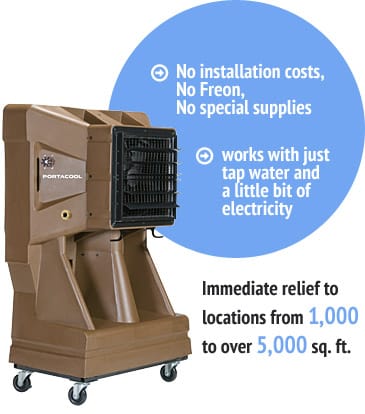
These coolers work quietly with no misting or sprays and can bring the temperature of an area down by as much as twenty degrees. They work with tap water and just a little electricity and don’t require much setup or ongoing power.

Like spot coolers, evaporative coolers come in a variety of sizes and can cool spaces from 1,000 to 5,000 square feet. 

Rent a Power Breezer Fan

Another option to cool your apartment without windows is a power breezer fan rental. These fans are self-contained and you can plug them into a regular outlet. They use no chemical coolants; they cool a space by just using water and air.

Power Breezer fans are small and can cool areas of up to 3,000 square feet. In some cases, they can lower the room temperature by as much as twenty-seven degrees.  

Happy Cooling

No matter what method you choose, you will be experiencing cooler temperatures in your apartment without windows soon. Whether you try the old standbys or take the leap and rent a cooling machine for your space, cool relief will make a big difference in your home, your apartment and your life. Stay cool!

portacool pacjs2601a1
Uncategorized

It never fails. You have a crucial manufacturing order to get out the door. It’s the middle of the Texas summer, and temperatures are above 100 degrees. Naturally, this is the time your industrial air conditioner unit chose to just fizzle out. It will take three days to fix, and the company doesn’t do repairs on weekends. You need 24/7 operations to keep your business going. You can’t close down your shop. You have to keep everyone working on the line. What do you do?

How Portable Air Conditioners Can Help

In this situation, a portable air conditioner can be a lifesaver. Spot Coolers are portable air conditioners that deliver a jet of cold air where you need it the most. A spot cooler is a type of portable air conditioner designed to cool a hot spot in a factory, hospital or any industrial or commercial space. For example, we set up spot coolers quite frequently in computer data centers to cool server racks, or in hospitals to keep patients comfortable and medical equipment cool.

Many factories use these coolers to ensure that workspaces or equipment does not overheat. We even install them in commercial buildings during our hot Texas summer months when building A/C is too strained and is just not doing the job. During the summers, as you might imagine, we install quite a few of these units in emergency situations when the building’s primary air conditioner fails or must undergo maintenance. We all know how quickly a building can heat up in this brutal Texas sun when there’s no working A/C.

As a business, you avoid the cost of cooling an entire building or even an entire room. Our rental rates are very affordable, and we often find that one spot cooler can do the job. We can recommend the right unit for you so that you get efficient and cost-effective cooling for your industrial or commercial application. The units can provide temporary or permanent cooling, so you can shut it off when you don’t need it running.

Industrial Cooling Costs

In a recent U.S. Department of Energy (DOE) study, they found that about 40 percent of energy costs for an average-sized commercial building is spent on cooling and heating. In fact, cooling and heating can amount to about eight percent or higher of your total overall building costs. One way to reduce these costs is to only cool the space you need to cool. Becoming more energy-efficient can save businesses 22 to 56 percent in costs, depending on factors like building size, building use, regional climate, and local utility costs. As a building owner, imagine what you could do with these types of costs savings.

Sometimes, the cost of cooling a particular area with sensitive, expensive equipment pales in comparison to the replacement cost of that equipment. Some businesses have spot coolers during emergencies. The cost of the spot cooler is minimal compared to the cost of completely shutting down your operations for an A/C repair or replacement.

Heating, ventilation, and air conditioning (HVAC), as well as lighting, are certainly essential for a productive business, so it is no surprise that these are the two highest energy costs for commercial buildings like warehouses, hospitals, retail stores, and similar structures. Did you know that these commercial spaces consume nearly 20 percent of the energy in the United States?

As a business owner, you want to do everything you can to reduce your energy costs. The amount of energy you use depends on the time of day you use it, the climate and the types of equipment and lighting you have. Your building’s age, windows, and insulation are also factors. Your utility plan is also a factor, and usually includes both demand (capacity) and consumption charges. If you’re lucky, your utility provider will let you choose which tariff plan you are on – either demand or consumption – and will often provide you a rate comparison. Switching tariffs could save you a surprising amount of money.

Spot coolers can save you money as well. These spot cooler units reduce the need to cool the whole building and can cool spaces ranging from 200 square feet up to 2,100 square feet. These spot coolers work just like the air conditioner in your home by using a chilled refrigerant to cool air as it runs over coils. Spot coolers also remove moisture from the air as it cools. All of our spot coolers have easy-to-use digital controls.

Evaporative Cooling

If you have a very large indoor space, evaporative cooling is sometimes a good option compared to or in addition to air conditioning. Evaporative coolers reduce temperatures by evaporating liquid and adding it to space. In general, these coolers are used to keep facilities about 20 degrees cooler than outside temperatures. On the other hand, an air conditioner removes both heat and moisture from the space, therefore cooling and dehumidifying the room to a set temperature that will be maintained.

Evaporative coolers are more economical than air conditioning, and also tend to be more energy-efficient. An air conditioning system can cost up to five times more than an evaporative cooling system. The evaporative coolers are inexpensive to install and require minimal maintenance. They are mainly used in hot, dry climates, so depending on where you are in Texas, this might be a good cooling option for you.

At Preferred Climate Solutions, we will help you choose the system that best suits your needs. We rent units ranging from 10,000 – 83,000 BTU, and we offer on-site delivery, setup, and pick up when you no longer need the unit. The great thing about these units is that they are self-contained; they operate off the regular 120V electrical supply and just roll into place wherever you need them.

Preferred Climate Solutions can provide spot coolers as well as other cooling solutions to keep your business running. We also rent evaporative coolers for outdoor or larger indoor spaces and even large event AC units that can cool an entire building or structure.

We are Texas-owned and offer superior 24/7 service and fast response to fixing your cooling problems. We have offices in Houston, Dallas, and Austin, but we service anywhere in Texas. If you have a cooling problem, give us a call at 888.466.7180 or contact us. We will help you choose the right cooling equipment for the right job.


Scroll to Top